
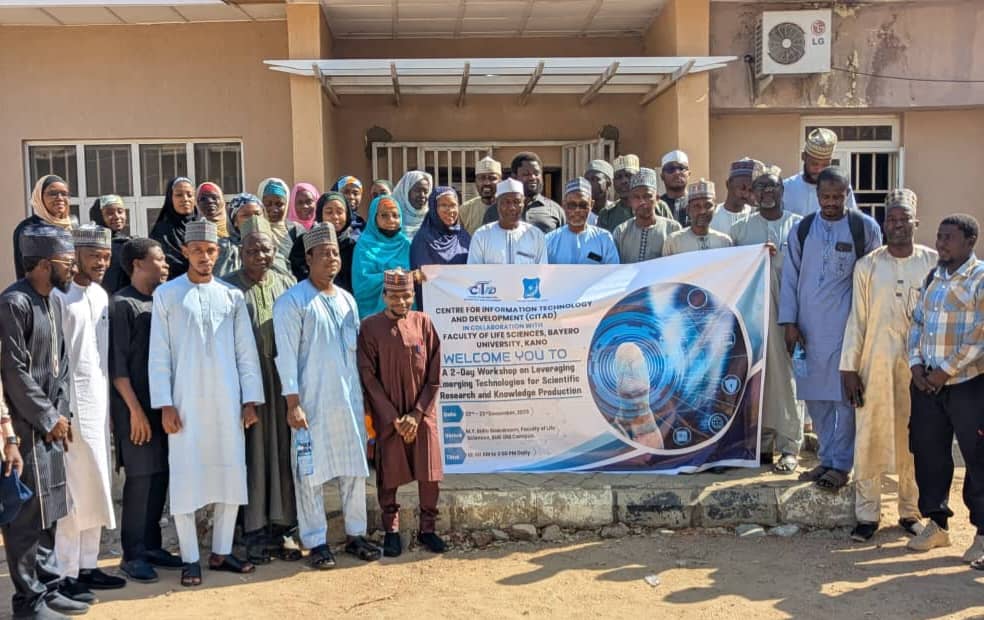

The Centre for Information Technology and Development (CITAD), in collaboration with the Faculty of Life Sciences, Bayero University, Kano (BUK), has urged Nigerian academics to embrace emerging digital technologies to improve the quality of research and knowledge production.
The call was made at the end of a two-day capacity-building workshop for academic staff of the faculty, held from Monday to Tuesday at BUK.
Speaking at the event, CITAD’s Human Resource Officer, Mr. Sani Sa’idu Muhammad, said the training was organised to bridge the widening gap between academic research and societal needs.
“Emerging digital technologies are reshaping the way knowledge is generated, applied and shared across the globe,” Muhammad said. “If our academics are not equipped with these tools, our research risks becoming disconnected from real-world development.”
He added that empowering lecturers with skills in artificial intelligence (AI), blockchain and digital research tools would have a multiplier effect. “When lecturers are digitally empowered, students benefit, institutions grow stronger and society ultimately gains,” he noted.
The workshop, which attracted 41 participants, focused on the application of digital tools, AI and blockchain technology in scientific research, with emphasis on data management, experimental design, research publication and data integrity.
Also speaking, the Sub-Dean of the Faculty of Life Sciences, Prof. Hajara Adamu, described the training as timely and impactful.
“This workshop has broadened our understanding of how AI and blockchain can support scientific research, especially in data handling and publication processes,” she said. “CITAD’s practical approach made complex digital concepts easy to understand and apply.”
Participants also shared positive feedback on the programme. Prof. Shamsuddeen Umar said the hands-on sessions would significantly enhance research outcomes.
“The practical demonstrations on AI and blockchain will improve the accuracy of our research data and help streamline the publication process,” he said.
Similarly, Fiddausi Ado Dandawaki said the training exposed academics to digital tools capable of transforming research output. “This experience has opened our eyes to new possibilities in knowledge dissemination and collaboration,” he said.
On his part, Prof. Abdulkadir M. Magashi described the programme as a critical intervention in the academic sector.
“Integrating emerging technologies into teaching and research will not only improve quality but also enhance the global visibility of our academic work,” he said.
The Chairman of the workshop, Prof. Ibrahim L. Abdullahi, said the training boosted participants’ confidence in applying digital tools to both teaching and research.
“Many of these technologies were simplified to suit life sciences research, and that has made participants more confident to adopt them in their work,” he said.
Mr. Muhammad added that the programme aligned with CITAD’s mandate of promoting digital literacy, innovation and research integrity through strategic partnerships and capacity-building initiatives.
“This is just one of many steps we are taking to ensure Nigerian academics are not left behind in the digital transformation of research,” he said.